A Quarter-Inch Difference in Your Legs Can Wreck Your Back.
Here's the Simple Solution.
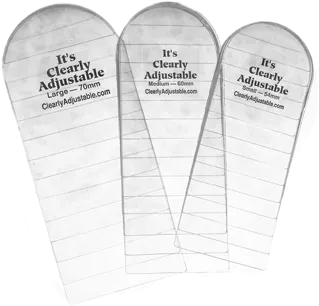

Announcing Clearly Adjustable Heel Lifts!
Most people who land on this page have been dealing with something for a while. Maybe it's a nagging lower back that never fully goes away. Maybe a hip that sits crooked. Maybe a podiatrist or chiropractor mentioned leg length discrepancy and you're trying to figure out what that actually means and what to do about it.
The answer, more often than people expect, starts with something very simple — a firm wedge that sits inside your shoe and raises your heel by a carefully measured amount.
That's what the Clearly Adjustable heel lift is. Not a cushion, not a pad, not an insole. A precisely engineered orthopedic heel lift designed to do one thing exceptionally well: give your body the mechanical correction it needs, in a form that actually holds up to daily life.
Why Most Heel Lifts Fall Short
Walk into any pharmacy and you'll find a shelf of foam and gel heel inserts. They're soft, they're cheap, and for most therapeutic purposes they don't work — or they actively make things worse.
Here's why. Soft materials compress under body weight. That means the height you think you're getting isn't the height you're actually getting once you've been walking on it for an hour.
Worse, a soft insert lets your heel sink and shift with every step, which creates friction inside the shoe. That friction irritates tendons, causes rubbing and calluses, and wears down your socks and shoe lining faster than you'd believe.
For conditions like leg length discrepancy, Achilles tendonitis, hip misalignment, or lower back pain — where the whole point is precise, consistent heel elevation — soft inserts simply can't deliver what you need.
Firm heel lifts are what the clinical literature actually recommends. And firmness is where the Clearly Adjustable lift starts.
What Makes This One Different
It's the only heel lift that shapes to your shoe.
The Clearly Adjustable heel lift is made from a clear, multi-layered vinyl material that conforms to the heel pocket of your shoe when placed under the footbed or insole. It molds to the shape of the shoe itself — which means both shoes end up fitting and feeling the same, something that matters a lot when you're wearing lifts all day every day.
The design is longer than standard heel lifts, with a gradual constant slope rather than an abrupt wedge. That longer slope supports the arch and eliminates the "bridging" effect — the uncomfortable gap between the heel and ball of the foot that short, steep lifts create. Your foot rests naturally across the full length of the lift rather than tipping forward off a cliff.
The material is firm enough to hold its height precisely, even with extended daily use. It doesn't compress, doesn't flatten, and doesn't lose its shape over months of wear the way foam eventually does.
And because it's transparent, it's nearly invisible in sandals and open-heel shoes — it takes on the color of the shoe itself rather than showing up as a white or black wedge underneath your foot.
The Part That Changes Everything — Exact Adjustability
This is what separates the Clearly Adjustable lift from every other firm orthopedic heel lift on the market.
There are other adjustable lifts, but they're typically made of compressible foam and they're only adjustable in increments of 1/8". That's three times the thickness of a layer in the Clearly Adjustable Heel Lifts. Clearly Adjustable fit you far more precisely, and they don't compress like foam lifts do.
The lift is built from multiple thin layers. Peel one off and you reduce the height by 1mm. Add one back and you raise it by 1mm. The total range runs from 1mm up to 12mm — roughly half an inch — and you can change it at any time without buying a new product.
That might sound like a minor convenience. It's actually clinically significant.
For leg length discrepancy: Most people don't walk in at exactly the right lift height on day one. Bodies need time to adapt, especially if the discrepancy has been unaddressed for years. Being able to start low and gradually increase over weeks gives your muscles, joints, and connective tissue time to adjust without being shocked into a new compensation pattern.
For Achilles tendon therapy: Recovery requires gradually reducing heel elevation as the tendon heals and re-lengthens. With a fixed-height lift, you either stay too high too long or make a sudden drop that re-injures the tendon. With an adjustable lift, you step down 1mm at a time, on whatever schedule your provider recommends.
For general fit: Different shoes have different heel pocket depths. The height that fits perfectly in your work shoes might be too much in your dress shoes. Adjustability lets you dial in the right height for every pair.
Three sizes — small, medium, and large — cover essentially all shoe types. The right size is determined by the width of the heel pocket in your shoe, not your shoe size. Fitting takes seconds, no adhesives or tape required. A stair-stepped bottom grips the heel pocket and stays put.
What It's Used For
The Clearly Adjustable heel lift isn't a single-purpose product. The same design, used with different heights and configurations, addresses a surprisingly wide range of conditions.
Leg length discrepancy and short leg syndrome — The most common use. When one leg is shorter than the other, the body compensates in ways that accumulate into hip pain, back pain, knee stress, and uneven gait over time. A properly fitted heel lift for leg length discrepancy placed in the shoe of the shorter leg restores balance at the foundation. Because the lift sits under the insole rather than on top of it, it's the least intrusive correction available — you feel the difference without feeling the lift.
Achilles tendonitis — Raising the heel reduces tension on the Achilles tendon, giving chronically inflamed or healing tissue a chance to recover without being constantly re-stretched with every step. The firm material is essential here — soft lifts cause the heel movement that makes tendonitis worse, not better.
Lower back pain and hip alignment — A leg length discrepancy, even a small one, tilts the pelvis and forces the spine to compensate. Over years, that compensation becomes chronic pain. Heel lifts for hip alignment and back pain work by correcting the imbalance at the source rather than treating the symptoms further up the chain.
Rehabilitation and prosthetic use — Post-surgical recovery, stroke rehabilitation, amputee fitting, and tight-tendon conditions all benefit from firm, precise, day-to-day adjustable heel elevation. The Clearly Adjustable lift is widely used in clinical and physical therapy settings for exactly this reason.
Active sports — running, skiing, skating, tennis, golf — Athletes with leg length differences or Achilles issues still need to train. Thin layers of the lift also work as heel pocket shims in athletic shoes and boots, reducing heel slippage, eliminating chafing, and improving control. Golfers in particular: peer-reviewed research found that heel lift use by amateur golfers added an average of 44 yards to drives and improved accuracy by 8 yards — the lift shifts weight forward onto the ball of the foot, which is exactly where it should be at impact.
Varus and valgus correction — By trimming and rearranging individual layers, the lift can be configured to provide side-to-side angular correction of up to 5 degrees without changing overall heel elevation. This addresses inward or outward rolling of the ankle without requiring a separate orthotic wedge.
Sandals — Most heel lifts are useless in open-heel shoes because they're visible and unstable. The transparent Clearly Adjustable lift is nearly invisible under the foot and wide enough to stay stable without the heel enclosure of a closed shoe.
An Honest Note
Heel lifts work great for a lot of people, but not for everyone, and there are situations where they can create secondary problems if used incorrectly — particularly if the height is too much, introduced too fast, or used without addressing the underlying cause.
You should get a professional opinion about using any heel lift before you begin using them. This page gives a comprehensive list of who you should consult with before you begin.
There's a full, honest discussion of the potential side effects and tradeoffs at Why Not Use Heel Lifts? — worth reading before you commit, especially if you're planning on significant elevation.
And if you're not sure which product is right for your specific situation, the product selection guide walks through the key decision points clearly.
Ready to Find Out More?
The Clearly Adjustable heel lift is available through authorized vendors, online and by phone. Find them here.
Disclaimer: This content has been compiled from clinical literature and reputable medical sources for educational purposes only. It is not a substitute for professional medical advice. Leg length discrepancy should always be evaluated and managed by a qualified healthcare provider.
Some content on this page has been updated using AI.
©2002–2026 Clearly Adjustable.